Office Corporate Culture: How to Make a Company's Future Direction Visible
Alessandro Nicotra
Workplace Intelligence

In short
— Spaces are among the most visible signs of a corporate culture. They can support change or slow it down.
— A brief survey reveals how employees experience the culture today and how they wish it to be. The gap in between is the mandate for the space.
— Concrete decisions emerge from this gap: more places for exchange, less distance from leadership, more room for experimentation.
Every office tells the story of how a company works: who sits where, where people meet, how open doors are. But often, it tells the story of yesterday's culture. Anyone planning an office is therefore also planning tomorrow's culture. To do that, you first need to know where you stand today and where you want to go.
An office that reflects yesterday's culture makes change difficult.
What does corporate culture have to do with the office?
More than you might think. Organisational psychologist Edgar Schein describes culture on three levels: basic assumptions, espoused values, and artefacts. He explicitly includes the built environment, architecture, and office layout among the artefacts (Schein, MIT). They are visible, but not always easy to read.
The profound impact of physical space is demonstrated by a study on hot desking: employees with assigned desks identify more strongly with their team, while those without an assigned desk identify more strongly with the organisation as a whole. Spatial layout helps determine where people feel they belong.
How do you measure a company's culture?
By asking how the culture is experienced today and how it should be. The most well-known model for this is the Competing Values Framework by Kim Cameron and Robert Quinn. It captures both the current and preferred culture side by side (Cameron and Quinn, University of Michigan). The authors note that many change projects fail because the underlying culture remains the same.
In Workplace Intelligence, employees answer both aspects in the survey: How do you experience your company today, and how should it be? For example, regarding hierarchy, collaboration, innovation, flexibility, communication, transparency, autonomy, and work-life balance. The analysis overlays both pictures and shows where wish and reality diverge the most.
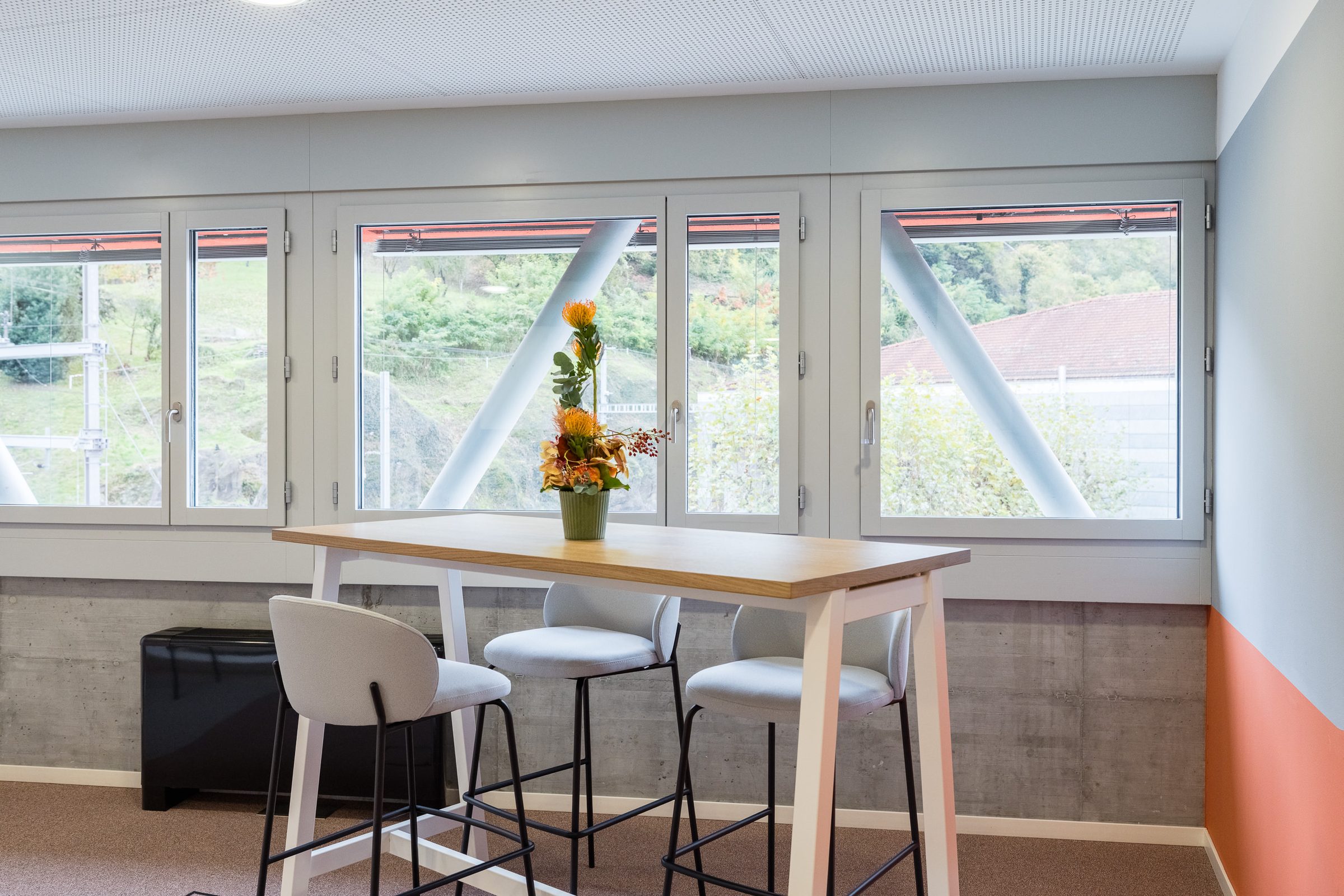
Coop Legal Protection, Bellinzona
How does a cultural gap turn into a spatial concept?
Every major gap asks a question of the space. If the team desires flatter hierarchies, the question arises where leadership sits and whether private offices are needed. If it desires more innovation, it needs places for experimentation that do not have to be perfect. If it desires more transparency, visual connections, open project walls, and spaces where decisions are made together all help.
This creates a briefing that is not based on taste, but on what the people in the company say themselves. At pom+ in Zurich, for example, exchange was at the centre. That is why the heart of the headquarters today beats in a multifunctional workshop space, complemented by many quiet retreat areas.
Why is this worthwhile for a company?
Because belonging retains people. In Switzerland, according to Gallup, only 8 percent of employees are emotionally strongly attached to their work. Space alone does not change this, but it plays a part: In the Gensler Global Workplace Survey 2025, 90 percent of employees who like their workplace are proud of their company. Among those who feel alienated from their environment, that figure is 47 percent.
And co-creation pays off. In experiments by the University of Exeter, participants in spaces they were able to help design worked significantly more productively than in stark, pre-set offices.
What does this bring to the company?
Targeted investments and employees who stay. Knowing the biggest culture gap allows investing where space makes the greatest difference, rather than spreading the budget evenly across the floor plan. This saves money in areas no one would have missed.
And it reduces one of a company's most expensive costs: turnover. According to Gensler, employees in very good work environments are almost three times more likely to stay with their company. The survey itself is quick: it typically runs for one to two weeks, after which the results are ready to serve as the foundation for workshops and design.

KAYAK Office, Zurich
Frequently Asked Questions
Can corporate culture even be measured?
Not exactly, but it can be made visible. A survey on the current and target state reveals how employees perceive their company and where they expect change.
Who should participate in the survey?
Ideally everyone. Leadership often perceives a different culture than the teams do. This very difference is particularly insightful.
Are the responses anonymous?
Yes. We only evaluate aggregated data; individual responses cannot be viewed.
What happens if the current and target states are far apart?
Then space is a powerful lever, but not the only one. We therefore support the transformation with workshops and change management so that spaces and behavior evolve together.
Does this also work without relocating?
Yes. Even in an existing office, zones, meeting places, and quiet areas can be rearranged once it is clear which culture they are meant to support.
Sources
Organizational Culture: A Dynamic Model, Edgar H. Schein, MIT Sloan, 1983
Diagnosing and Changing Organizational Culture, Chapter 1, Cameron and Quinn, 1999
Putting Employees in Their Place, Millward, Haslam and Postmes, Organization Science, 2007
State of the Global Workplace: Switzerland, Gallup, 2026
Global Workplace Survey 2025, Gensler, 2025
Designing your own workspace improves health, happiness and productivity, University of Exeter, 2010
Culture cannot be prescribed. But you can give it a place where it can grow.
Contact
Listening is our first draft.
Every project begins with a conversation. Tell us what you have in mind: a new working environment, a restaurant, a space for the future. We bring an open mind, curiosity, and experience in strategy, interior design, and lighting. We'd love to meet at our studio on Gutstrasse in Zurich. Or wherever your project is coming to life.